Adventure footage often fails between the exciting moments. A viewer sees a departure, a close-up of equipment and a distant summit but cannot tell how the pieces connect. More clips will not necessarily solve that problem. A sequence needs relationships: a person within a setting, an action with a visible purpose and a result that follows honestly. Plan for those relationships while accepting that some moments should happen without a camera.
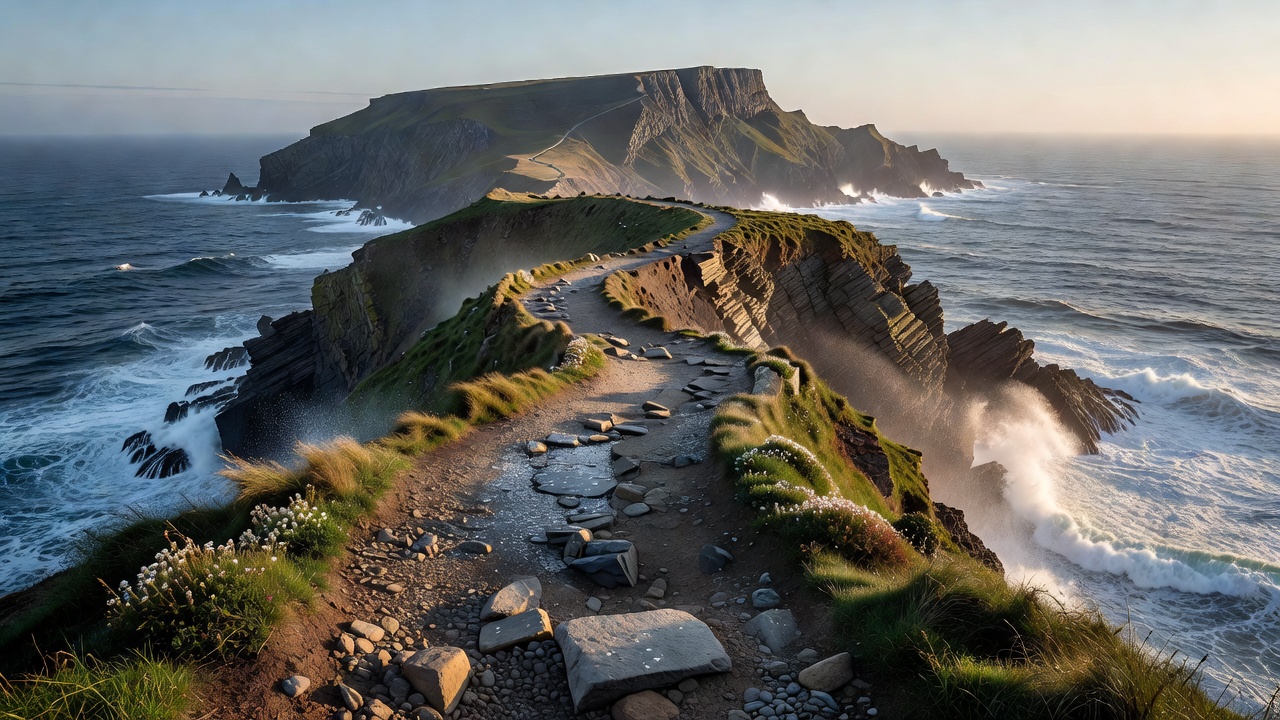
Place
A permitted, stable view that explains where the action begins.
Change
One observable movement or decision that advances the journey.
Consequence
The new situation, including a pause or return if that is what happened.
Establish geography before detail
Begin with a view that makes the setting legible. On a section of the South West Coast Path, a path entering a bay may explain more than a tight shot of boots. In a harbour, show the relationship between shore and vessel before cutting to a rope or bag. The establishing image does not need to be spectacular; it needs to answer “Where are we?”
Do not suggest that an attractive viewpoint is the start of a route if you reached it midway through the day. A caption such as “Later, above the harbour” preserves the image while clarifying chronology. Accurate orientation helps viewers enjoy a story without mistaking it for a complete route guide.
Film a task, not a performance
Look for actions that would happen without the camera: checking a public information board, packing away a layer or waiting for a guide’s instruction. Each one carries information about conditions or progress. Ask whether the image helps explain the journey. If its only function is to make someone look adventurous, you may not need it.
Never repeat a difficult crossing, launch or exposed movement for coverage. Do not ask a companion to walk backward, move closer to an edge or ignore a guide so that a shot matches your storyboard. An account recorded afterward can bridge an unfilmed section without turning a real activity into a staged risk.
Use continuity as a courtesy
When movement runs left to right across several shots, the viewer usually reads it as continuing in one direction. A sudden reversal may suggest a turn or return. That is not forbidden, but it needs context. Use a neutral landscape view, a clear caption or a spoken explanation when the actual route changes direction.
Keep the underlying geography honest. A detail from a sheltered bay should not stand in for an exposed passage if the edit implies that both happened together. In places such as Lake Bled or the Lofoten Islands, recognisable scenery can still be rearranged misleadingly. Beautiful footage is not an excuse to invent a route.
Let small observations carry meaning
One close detail can explain a change: water on a jacket after rain, a closed gate or a revised timetable. Record only what you can access without disturbing people or the environment. A sign is useful if it provides relevant context, but check that names, private information or sensitive directions are not exposed unnecessarily.
Ambient sound can connect images taken from different safe positions. Keep that connection truthful: sound recorded at another location should not imply a wildlife encounter or a warning that did not occur. Music may support rhythm, but use audio you have rights to publish and do not assume a platform’s licence applies to every export.
Choose pace after choosing meaning
Assemble a rough version without transitions or effects. Identify what each clip contributes: orientation, action, context or result. If two images do the same job, keep the clearer one. If a necessary link is missing, add a concise explanation instead of stretching unrelated footage into a false connection.
There is no universal number of seconds that makes a travel clip work. A complicated sign needs more reading time than a familiar action. Watch on a small screen and check whether captions obscure the important detail. Test the piece with sound off, and provide accurate captions for speech rather than relying only on automatic transcription.
Give the sequence a truthful consequence
The ending should reveal the new situation, not merely the prettiest remaining image. Perhaps you reached the meeting point, abandoned the walk or discovered that the return connection shaped the entire day. A changed plan can be the most informative consequence because it connects conditions with judgment.
Before publishing, check the sequence against your notes. Did the weather change between clips? Did you combine different days? Are you implying that a guide, operator or companion approved something they never saw? Identify reconstructions and archive footage where they matter. Then remove any image whose dramatic effect depends on the viewer misunderstanding what happened.